#Experience Design
#UX Research
#Service Design
Redesigning Waiting as an Experience
Waiting has always been seen as a gap, something frustrating, unproductive, and necessary to endure. But in public service systems, it shapes far more than just time. It influences trust, perception, and the overall experience of the system itself. By studying the Passport Seva Kendra system, it explores how communication, environment, and process structure shape how waiting is felt, and how it can be made clearer, more predictable, and less stressful.
Focus
Experience design for
waiting in PSK
Type
Group Project
Year
2026

About the project
Understanding waiting as the visible experience of complex public systems like Passport Seva Kendra in India.
A service shaped by layered legal frameworks, operational processes, and multiple verification networks. While these backend mechanisms ensure security and accuracy, they introduce delays that are most visibly experienced by citizens as waiting.
The project examines how this gap between system complexity and user visibility shapes perception. It identifies that waiting is not defined by time alone, but by uncertainty, lack of communication, and limited feedback, reframing it as a critical component of the service experience that can be designed to improve clarity, trust, and overall satisfaction.


Process
Mapping the system, understanding perception, and reframing waiting as a design problem.
The process began with building a foundational understanding of the PSK ecosystem, studying its legal frameworks, operational structure, and service flow. The system was mapped across frontstage interactions (queues, counters, token systems) and backstage processes (verification networks, approvals, and inter-departmental coordination), revealing how invisible operations shape the visible experience of waiting.
The approach was structured using Jesse James Garrett’s 5 Elements of UX, moving from strategy and scope to structure, skeleton, and surface. This helped translate high-level insights into tangible service interventions, ensuring alignment between system intent and user experience across touchpoints.
Primary research combined qualitative interviews and quantitative surveys, capturing both emotional and behavioural insights. Findings revealed that waiting is heavily influenced by uncertainty, lack of communication, and high cognitive load, rather than duration alone.
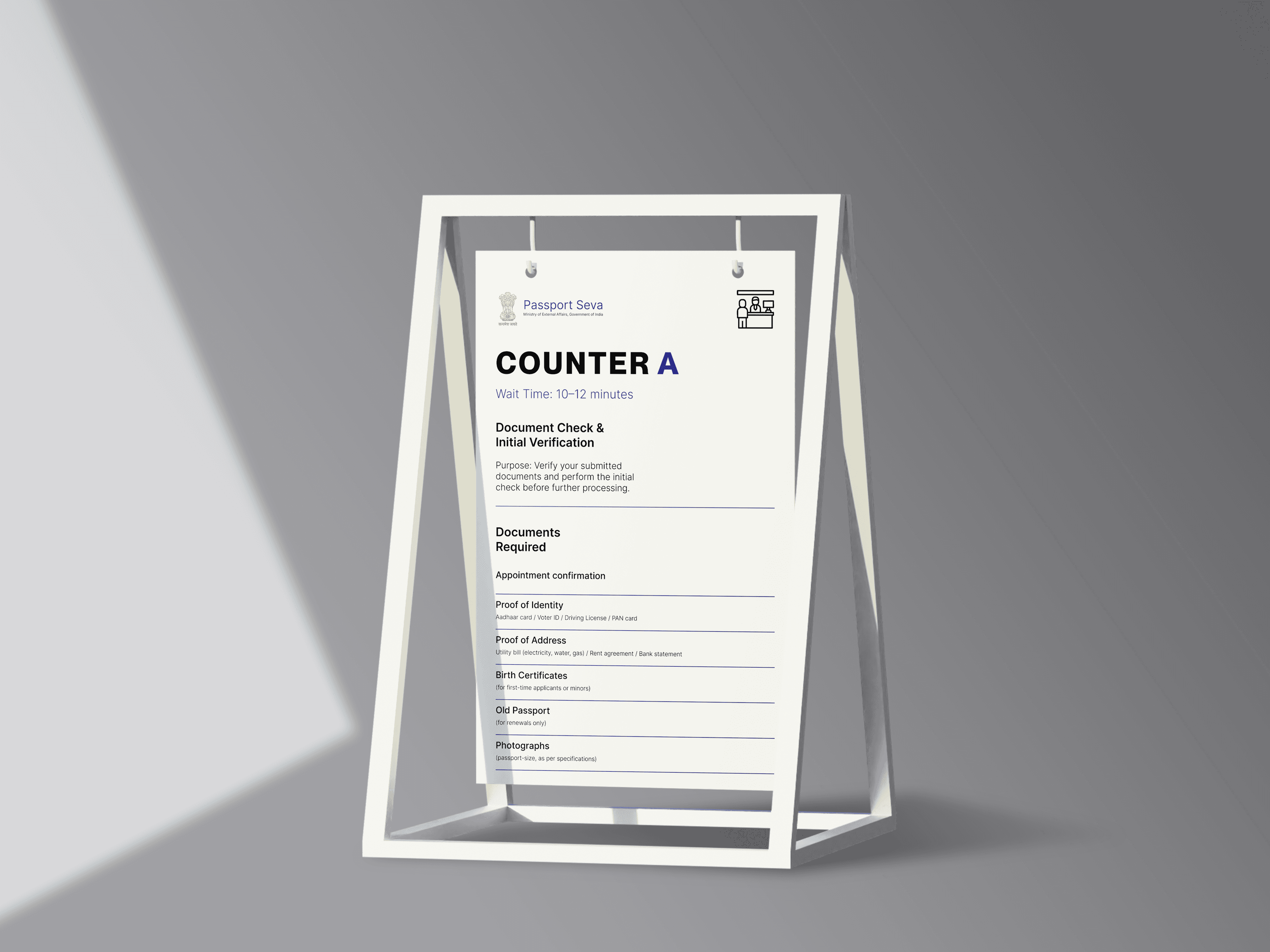
These insights were synthesised through service blueprints, journey maps, and personas, mapping the end-to-end experience across application, verification, and delivery stages. This was further supported by information design interventions for PSK centres, focusing on clearer guidance, wayfinding, and communication within physical spaces.
A gap analysis identified core issues such as inconsistent information, lack of transparency, overwhelming environments, and limited support systems. In response, concepts like the PSK Tool Peti were developed as supportive system interventions, alongside an implementation roadmap outlining how improvements could be integrated across different layers of the service.
This led to a reframing of the problem, from reducing waiting time to redesigning the experience of waiting itself, focusing on transparency, guidance, reassurance, and communication as key levers within the system.

Impact & Relevance
The project reframes waiting as a critical component of service design rather than an unavoidable delay.
By shifting focus from duration to perception, it highlights how factors such as communication, transparency, and environment shape how time is experienced within public systems.
Through this lens, the work demonstrates that meaningful improvements in user experience do not always require reducing waiting time, but redesigning how that time is structured, communicated, and supported. Interventions across information design, guidance systems, and service touchpoints show how clarity and reassurance can significantly improve user perception and trust.
It demonstrates how even within complex, constraint-heavy systems, experience design can create meaningful impact without altering the core process itself.
DISCOVER MORE
Want to check more?
Discover other projects.

Focus
Experience design for
waiting in PSK
Type
Group Project
Year
2026
#Experience Design
#UX Research
#Service Design
Redesigning Waiting as an Experience
Waiting has always been seen as a gap, something frustrating, unproductive, and necessary to endure. But in public service systems, it shapes far more than just time. It influences trust, perception, and the overall experience of the system itself. By studying the Passport Seva Kendra system, it explores how communication, environment, and process structure shape how waiting is felt, and how it can be made clearer, more predictable, and less stressful.
About the project
Understanding waiting as the visible experience of complex public systems like Passport Seva Kendra in India.
A service shaped by layered legal frameworks, operational processes, and multiple verification networks. While these backend mechanisms ensure security and accuracy, they introduce delays that are most visibly experienced by citizens as waiting.
At PSK, the service unfolds across two interconnected layers: the backstage, where processes like identity verification, approvals, and coordination take place, and the frontstage, where users interact with queues, counters, and status updates. Although users only encounter a fraction of the system directly, their experience is heavily influenced by what happens behind the scenes.
The project examines how this gap between system complexity and user visibility shapes perception. It identifies that waiting is not defined by time alone, but by uncertainty, lack of communication, and limited feedback, reframing it as a critical component of the service experience that can be designed to improve clarity, trust, and overall satisfaction.
Process
Mapping the system, understanding perception, and reframing waiting as a design problem.
The process began with building a foundational understanding of the PSK ecosystem, studying its legal frameworks, operational structure, and service flow. The system was mapped across frontstage interactions (queues, counters, token systems) and backstage processes (verification networks, approvals, and inter-departmental coordination), revealing how invisible operations shape the visible experience of waiting.
The approach was structured using Jesse James Garrett’s 5 Elements of UX, moving from strategy and scope to structure, skeleton, and surface. This helped translate high-level insights into tangible service interventions, ensuring alignment between system intent and user experience across touchpoints.
Primary research combined qualitative interviews and quantitative surveys, capturing both emotional and behavioural insights. Findings revealed that waiting is heavily influenced by uncertainty, lack of communication, and high cognitive load, rather than duration alone.
These insights were synthesised through service blueprints, journey maps, and personas, mapping the end-to-end experience across application, verification, and delivery stages. This was further supported by information design interventions for PSK centres, focusing on clearer guidance, wayfinding, and communication within physical spaces.
A gap analysis identified core issues such as inconsistent information, lack of transparency, overwhelming environments, and limited support systems. In response, concepts like the PSK Tool Peti were developed as supportive system interventions, alongside an implementation roadmap outlining how improvements could be integrated across different layers of the service.
This led to a reframing of the problem, from reducing waiting time to redesigning the experience of waiting itself, focusing on transparency, guidance, reassurance, and communication as key levers within the system.
Impact & Relevance
The project reframes waiting as a critical component of service design rather than an unavoidable delay.
By shifting focus from duration to perception, it highlights how factors such as communication, transparency, and environment shape how time is experienced within public systems.
Through this lens, the work demonstrates that meaningful improvements in user experience do not always require reducing waiting time, but redesigning how that time is structured, communicated, and supported. Interventions across information design, guidance systems, and service touchpoints show how clarity and reassurance can significantly improve user perception and trust.
It demonstrates how even within complex, constraint-heavy systems, experience design can create meaningful impact without altering the core process itself.
DISCOVER MORE
